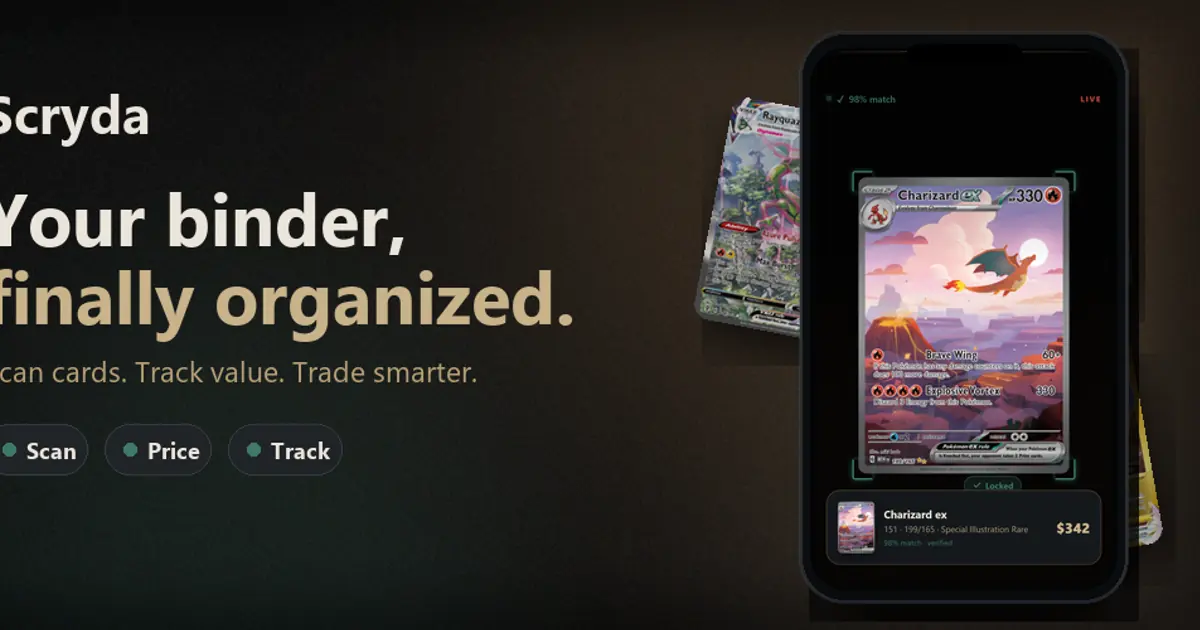
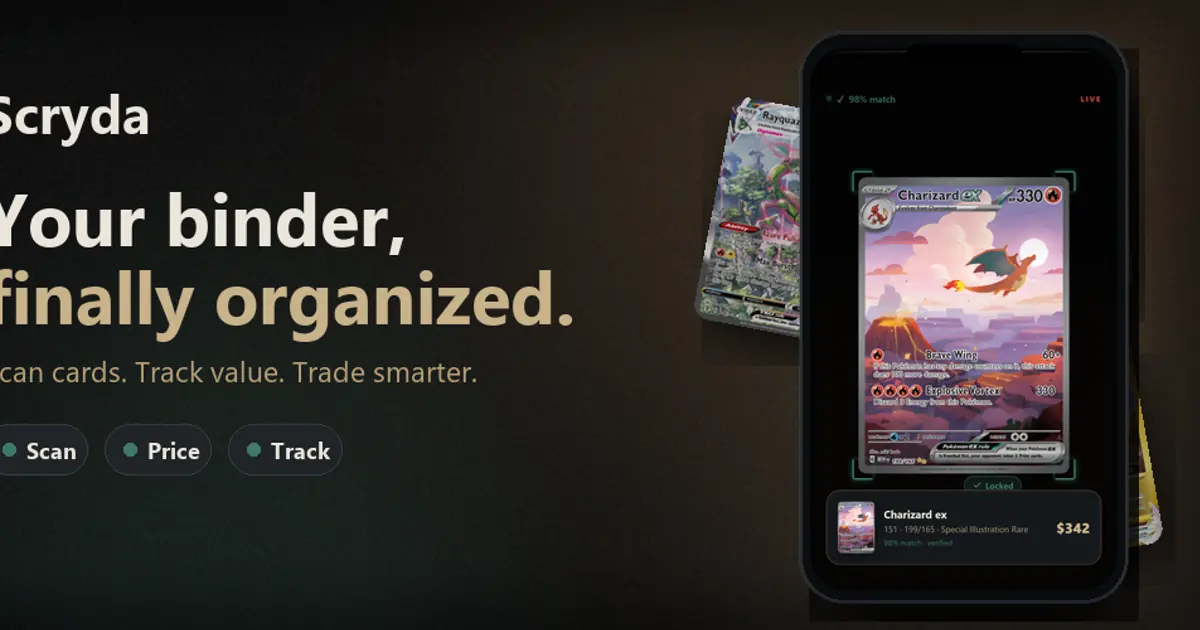
Scryda — the app that scans, identifies, grades, and price-tracks your trading cards — is out now on Google Play for Android. Here's what's in it.
It's live. Scryda is on Google Play, which means anyone on Android can now point their phone at a trading card and have the set, the print, a condition estimate, and a current market price land in their collection about a second later. No more shoebox-and-spreadsheet evenings.
You can grab it here: Scryda on Google Play.
That's the headline. The rest of this is what you actually get when you install it, who it's for, and a few honest notes about what it does and doesn't do.
What Scryda does
At its core it's a card scanner that works across five games: Pokémon, Magic: The Gathering, Yu-Gi-Oh!, Lorcana, and One Piece. Open the camera, frame a card, and the app reads it. Recognition runs on a mix of text extraction and visual matching — text alone gets tripped up by reprints and alternate arts, image matching alone struggles with glare and worn cards, so doing both is what lets it handle a scuffed reverse-holo from 2016 and a fresh etched card from last week.
A few things it gets right that quick-scan apps usually don't:
- It reads holofoil, reverse-holo, and etched cards, not just flat matte ones.
- It recognizes Japanese, Korean, and European prints, which routinely break English-only databases.
- Basic scanning works offline, so a convention floor with dead Wi-Fi doesn't stop you.
Once a card is in, it's not just a photo. It carries its set, print edition, a condition estimate, and a price that refreshes daily — and that's where the app stops being a scanner and starts being a ledger you can actually trust.
The four things people actually use it for
Knowing what they own. Scan cards into binders and folders, filter by set, rarity, or condition, and watch a running total for the whole collection. For most people this is the whole reason — they genuinely don't know what the pile in the closet is worth until it's in one place. It's usually either more or less than they guessed, and both are worth finding out.
Watching prices. Prices update daily from TCGplayer and the other big marketplaces, and every card gets a 90-day history chart. Set a target and price alerts ping you when a card hits it, so you're not opening the app ten times a day to check one number.
Estimating a grade before paying for one. Scryda scores surface, centering, corners, and edges into a PSA-equivalent estimate. It will not replace a real grade — nothing will — but it tells you whether a card is even worth the submission fee. Mailing a card that comes back a 7 to a grader is how you set $25 on fire. If you want the full picture on what the numbers mean, the PSA grading guide covers it.
Sizing up trades. Put what you're giving on one side, what you're getting on the other, and see whether the deal is fair once condition is factored in. The most common way people lose a trade is pricing a played card at near-mint value from memory. A real number in the moment fixes that.
Want the deeper version of all this? The features page walks through every tool with screenshots, and "What is Scryda?" is the longer explainer.
Download Scryda on Google Play →
What it costs
The free tier is the real thing, not a trial that nags you. Unlimited scans, full collection tracking with daily price updates and history charts, and 25 grade estimates a month — which is more than most collectors burn through. No credit card to start.
If you push the app harder, one paid tier stacks on top:
- Pro ($2.99/mo) bumps grade estimates to 300 a month and adds batch scanning (keep the camera open, review a whole tray at once), price alerts, the trade evaluator, sale logging, CSV export, and no ads.
Yearly billing drops the rate to about $2.50/mo. The full breakdown is on the pricing page, and if you're unsure whether it's worth it, the honest answer is usually "stay free" — the free vs Pro piece spells out exactly who the paid tier is for.
What's in this version
The build going out is 1.2.0, and it's the most complete Scryda has been. Recent additions worth calling out: you can search the full card catalog from home without scanning first, price alerts now actually send a push when a card hits your target, and a Trends tab shows your top movers and your collection's value over time. Set pages tell you the cost to complete a set, scanning remembers your condition and variant between cards, and the whole thing starts faster and scrolls smoother. The changelog has the line-by-line if you want it.
Who should bother
Honestly, anyone with more than a couple hundred cards. The casual collector who just wants to know what's in the box. The player who trades constantly and is tired of getting nickel-and-dimed. The person clearing out a relative's old collection with no idea whether it's $40 or $4,000. And sellers moving real volume, who need batch scanning and sale logging to keep up.
If your collection is twenty cards, you can hold those in your head — you don't need an app. The value kicks in somewhere past "I've lost track."
Start with whichever game you collect — the Pokémon page is a good first look at what's supported — then point your camera at your most valuable card and see what comes back.
Get Scryda on Google Play. It's free to start, and an iOS release is on the way.
Frequently asked questions
Is Scryda free? Yes. The free tier includes unlimited scans, full collection tracking, daily price updates with 90-day history charts, and 25 grade estimates a month — no credit card. Pro ($2.99/mo) adds higher limits and extra tools.
Where can I download it? On Android, it's on Google Play now. An iOS version is in the works; the download page will have both as soon as it ships.
What card games does it support? Pokémon, Magic: The Gathering, Yu-Gi-Oh!, Lorcana, and One Piece — all in one collection, including many Japanese, Korean, and European prints.
Does it work offline? Basic scanning does. Price updates and grade estimates need a connection, since they pull live market data.
Can it really grade my cards? It gives a PSA-equivalent estimate from surface, centering, corners, and edges. It's there to tell you whether a card is worth submitting to a real grader — not to replace one.
Share this article
Browse the card catalogue
Full card lists and live market prices, free and with no sign-up.
Related articles